The right card payment machine for events in the UK depends on where the payment happens. A staffed bar needs a portable card machine on 4G, a merchandise stand may need nothing more than a card reader paired to a phone, and a locker bank or kiosk needs an unattended terminal that works with nobody beside it. Most events run a mix. This guide covers the device types, when PDQ machine hire makes sense, whether you need a merchant ID, and what to ask about connectivity, settlement, fees and reconciliation.
Five device types cover most events
Countertop card machines sit on a fixed bar or box office counter, take power from the mains and connect by Ethernet or Wi-Fi. They accept chip and PIN and contactless and are the cheapest terminal to run per transaction, but they do not move.
Portable card machines run on a battery with a 4G SIM and Wi-Fi. Staff carry them along a bar or out to a table. They are the workhorse of festival bars because the terminal goes to the attendee rather than the other way round.
Phone-style card readers pair to a phone or tablet app by Bluetooth. They are small, cheap to buy and sold pay-as-you-go. UK providers publish flat in-person rates of 1.69% (SumUp) and 1.75% (Square) per transaction with no monthly fee, which suits traders and merchandise stalls with modest turnover.
Tap to Pay on a phone needs no reader at all. Apple launched Tap to Pay on iPhone in the UK in July 2023; it works on an iPhone XS or later with a partner app, and transactions are encrypted and processed through the Secure Element. Tap to Pay on Android works on NFC-equipped devices running Android 13 or later through providers such as Stripe. PIN entry is supported on both, but in the UK some card issuers require the card to be inserted for Strong Customer Authentication, so a phone cannot be the only device on a busy bar.
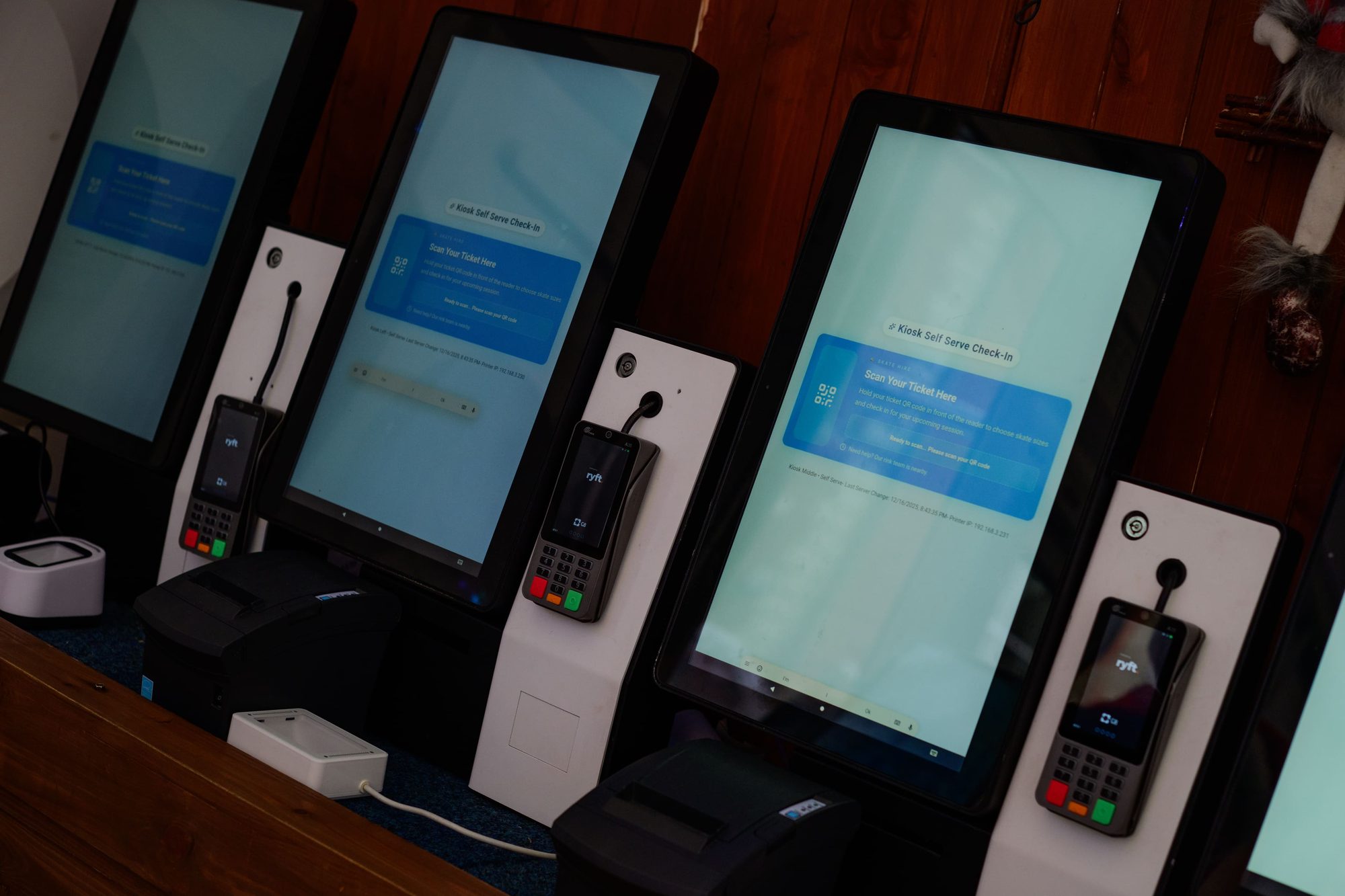
Unattended terminals are built into kiosks, lockers, vending and ticket machines. The PCI Security Standards Council lists unattended payment terminals as a device category under its PTS Point of Interaction standard and publishes a list of approved devices. If a supplier offers to fit a payment device into a locker bank or self-service kiosk, ask for the model’s PTS approval.
PDQ machine hire suits a short run with a known turnover
Hire companies supply countertop and portable terminals for a fixed period. One UK provider offers hire from three days to three months and markets it for festivals, exhibitions, auctions and farmers’ markets. Prices are quoted rather than published and depend on the number of terminals, the expected card turnover and the length of hire, with a refundable deposit, delivery, a set-up fee and per-transaction charges on top.
Hire makes sense for a one-off event, a seasonal peak or a first year when you do not yet know your card volumes. It stops making sense when the same venue trades most weekends: a monthly contract or outright purchase of pay-as-you-go readers costs less per day over a season. Lead time matters. A hire guide for exhibitors puts delivery at around five days if you have a merchant number that has been used before, around seven days for a new merchant number, and roughly ten days of bank approval on top if you have no merchant number at all. Book hire a month ahead.
A merchant ID is only needed when you process under your own account
A merchant ID (MID) is the account number an acquiring bank gives your business so that card payments settle to you. A traditional PDQ machine from a bank or acquirer needs one, and a hire company that supplies bank terminals will either ask for yours or arrange one, which is where the approval time comes from.
Phone-style readers and Tap to Pay apps from payment facilitators work differently. The provider holds the merchant account and onboards you as a sub-merchant, usually in minutes with a bank account and an identity check, so you do not need a merchant number to set up. The trade-off is less control: published flat rates rather than a negotiated rate, the provider’s rules on reserves and holds, and American Express may need a separate agreement.
For a multi-vendor event, who holds the MID decides who receives the money and who answers chargebacks months later. If every trader uses their own reader, each is paid directly and the organiser sees nothing. If the organiser holds one account and pays traders out, it needs automated onboarding and split payouts. LockerPay, our payments arm for locker and kiosk vendors, onboards a merchant with automated KYC and KYB checks, issues sandbox keys at once and typically has a live merchant within 24 hours, with automated splits to sub-merchants on daily settlement.
Connectivity decides whether the queue moves
A card terminal that cannot reach the acquirer is a paperweight. Event sites have three problems: mobile networks saturate when 20,000 attendees arrive, temporary Wi-Fi is shared with everything else on site, and a bar at the far end of a field may be beyond the mast. Put a 4G SIM in every portable terminal, ask for roaming SIMs that can switch networks, and treat site Wi-Fi as a backup rather than the main path.
Then ask the offline question. Some terminals queue transactions when the connection drops and submit them later; some accept contactless offline up to a limit; some simply decline. Ask the supplier three things: does the terminal queue offline, up to what value and how many transactions, and who carries the loss if a queued transaction is later declined. LockerPay’s kiosk integration runs an offline-tolerant transaction queue for exactly this reason. UK Finance counted 19.2 billion contactless payments in 2025, 39% of all payments, with cash down to 8%, so a bar that cannot take cards is a bar that is closed.
Settlement, fees and reconciliation
Settlement is when the money reaches your bank. Pay-as-you-go providers publish next-day or one-to-two-business-day timings: Square states that funds arrive within one to two business days, and SumUp states that funds are available in its business account by 7am the next day. Posso, our hardware and installation partner, offers next-day settlement on its card machines. Ask whether weekends and bank holidays push payout back, because a Saturday festival may settle on Tuesday, and traders and artists often expect to be paid before then.
Fees come in three shapes. Flat pay-as-you-go rates of around 1.69% to 1.75% per in-person payment with no monthly fee. Acquirer contracts with blended or interchange-plus rates, which a UK comparison site puts at roughly 0.6% to 3.5% plus 5p to 25p, alongside set-up fees of up to £150, merchant account fees of £15 or more a month and monthly minimum charges of £20 to £40. And short-term hire, which adds a hire charge, deposit and shipping to whichever rate applies. LockerPay prices on competitive blended rates for locker and kiosk volumes, and card processing on the VenueOra platform is quoted with your plan.
Reconciliation is where events lose money quietly. Name every terminal and map it to a bar, stall or locker bank before the gates open. Run end-of-day reports on each till and match them to the acquirer’s settlement report, not to a bank statement total. Export transaction-level data so a refund or chargeback can be traced to a terminal and a time. Reconcile daily during a multi-day event rather than once afterwards. Our guide to cashless festivals and arenas in 2026 covers wristbands and refunds, and PCI DSS for venues and attractions explains which merchant level your card volume puts you in.
What VenueOra does here
For staffed points, bars, box office and merchandise, we supply Posso card machines with contactless and chip and PIN and next-day settlement, alongside Posso ePOS. For unattended points, lockers and self-service kiosks, LockerPay provides certified Android and SoftPOS terminals that embed in the kiosk hardware or stand alone, with tap, chip and PIN, NFC and QR acceptance. Card data goes to a PCI DSS Level 1 acquiring partner, so card data never touches your tills, kiosks or lockers. Online ticket sales, kiosk payments and payments taken on a terminal from the order share one order record; bar sales on Posso tills are a separate system on which VenueOra processes the card payment. See card terminals for staffed and unattended points, payments on one ledger and festival ticketing, cashless and lockers; for self-service ordering see self-ordering kiosk costs and order value.
ePOS, kiosk and kitchen display hardware is supplied, installed and supported by Posso Ltd under our partnership. Performance figures are Posso’s, from its own customers.
This page describes how VenueOra’s products handle card data, personal data and age checks. It is not legal advice. Your premises licence conditions and your own data protection assessment take precedence.
Sources
- Apple introduces Tap to Pay on iPhone in the UK, Apple Newsroom, 13 July 2023
- Tap to Pay on iPhone: availability and supported devices, Stripe Docs
- Tap to Pay on Android: availability and supported devices, Stripe Docs
- PTS Point of Interaction (POI) standard and approved devices, PCI Security Standards Council
- Short-term card machine hire, 3 days to 3 months, Rapyd
- Our guide to short-term card machine hire, ExpoCart (lead times and merchant numbers)
- How much does a card machine cost? Fees explained, Mobile Transaction, 8 April 2025
- SumUp UK pricing, SumUp
- Card payments: fees and funds timing, Square UK
- Payment Markets Report 2025 key findings, UK Finance, 19 August 2026