A cashless festival payment system in 2026 is one of two things, and often both: open-loop payments, where attendees tap their own bank card or phone at every bar and stall, or closed-loop payments, where they load money onto an RFID wristband and spend it inside the site. UK arenas that have gone cashless have generally done so with open loop; festivals still use wristbands where connectivity, speed at the bar or control of the spend data make them worth the extra work. Whichever model a venue chooses, the measures of success are the same: short queues, plain refunds, every bar and stall reconciled on one ledger, and card data kept away from venue hardware.
Open loop or closed loop: the two ways to go cashless
Open loop means the attendee pays with something they already carry. Contactless cards, Apple Pay and Google Pay are tapped on card machines at the bar, or on phones running a certified payment app, which Apple calls Tap to Pay on iPhone and which on Android is usually called SoftPOS. UK attendees expect it: UK Finance counted 19.2 billion contactless payments in 2025, 39 per cent of all payments, with cash down to 8 per cent and 65 per cent of adults registered for a mobile wallet. Arena cashless payments in the UK follow this pattern. Braehead Arena in Glasgow, for example, moved to card and contactless only across bars, concessions and merchandise from September 2025, citing shorter queue times and a steady fall in cash use.
Open loop has a limit that matters at a busy bar. As of October 2026 the UK single-transaction contactless limit for cards remains £100, after which a PIN is required; the FCA sought views in 2025 on raising or removing the limit, including letting firms set their own, and UK Finance’s guidance notes that mobile wallets are not subject to the fixed £100 cap because the phone authenticates the payer. A round for eight at an arena bar can cross £100 on a card; on a phone the fixed cap does not apply.
Closed loop means the venue issues the money. Attendees link an RFID wristband to an account, load it with funds before or during the event, and tap the wristband at every outlet; the venue settles with traders afterwards. The wristband is also the ticket and the access credential, which is why festivals like the model: one tap at the gate, the bar and the locker. The costs are the top-up infrastructure, the refund process and the attendee’s uncertainty about their balance.
Many events now run both. The wristband handles the gate and the inside spend; open-loop contactless covers the car park, the merchandise tent and anyone whose wristband has failed.
Top-ups, refunds and what attendees expect
Closed loop lives or dies on top-ups and refunds. Boomtown’s published cash-free information is a useful picture of current UK practice: attendees link the code on their ticket to an account and top up through the festival app or website before and during the event; cash is not accepted on site; refunds of unspent balance are not automatic but are requested online after the festival within a two-week window and reach the account in 7 to 10 days; balances under 50 pence are not refunded and go to charity partners; and the system is free to use.
Those details are the ones attendees now check before they buy. The points to settle, and to publish on the event’s information pages, are whether the balance can be topped up online in advance and by card on site; whether top-up is free or carries a fee; how and when unspent money is refunded, including the claim window and any minimum; what happens to a lost wristband and whether the balance can be recovered; and whether the refund of a cancelled day’s spend goes back to the wristband or to the card.
Open loop has fewer of these questions, because the money never leaves the attendee’s bank. Its expectations are different: that every outlet takes a tapped phone, that a receipt is available, and that the queue moves.
Connectivity and the offline question
Every cashless system depends on connectivity somewhere, and the field is where it fails. A greenfield site with 40,000 phones on one mast, a basement arena bar with no signal, a merchandise stand at the far gate: each is a place where the card machine has to decide what to do when it cannot reach the network.
Put three questions to any vendor before signing. First, how the devices connect: venue Wi-Fi, mobile data, a private network or a mix, and who is responsible for it. Second, what happens when the connection drops: whether the device can take a payment and queue it for later authorisation, up to what value and for how long, and who carries the risk if a queued payment is later declined. Third, how the venue sees the state of the estate during the event: which devices are online, which are queuing and which have stopped. Closed-loop wristband systems are sometimes chosen because the balance check can be done locally; open-loop systems rely on the acquirer’s network for every authorisation. Either way, get the answer in writing and test it on site, not in the demo room.
One ledger across bars, merchandise and lockers
The second reason to go cashless is the data. A festival that runs twelve bars, a merchandise tent, food traders and a locker bank on separate systems spends the week after the event reconciling them. The aim is one ledger: every tap, whatever the outlet and whatever the method, posts to one record of sales against which refunds, trader settlements and VAT are worked out.
That ledger should also know who paid. A wristband is linked to a ticket holder; a tapped card can be linked to an account where the attendee chooses to; both allow spend to appear on the same guest record as the ticket. That is what makes loyalty, member pricing and per-head spend reporting possible, and it is what turns a festival’s payment data into next year’s marketing. Lockers belong on that ledger too: a locker hire paid by wristband or card is a transaction like a pint, and the guide to festival lockers in the UK sets out how hire and charging lockers fit a site. Choosing the devices themselves is covered in which card machine suits an event.
Where the card data goes
Open loop means card data, and card data means PCI DSS. The least work for a venue is for the card details never to touch its own equipment or code: the card machine or phone encrypts the card at the tap and sends it to the acquirer, the venue’s systems receive only a token and a result, and the acquirer carries the Level 1 obligations. Visa sets a merchant’s level by its total Visa transaction volume over twelve months, with Level 1 the highest tier and the most demanding validation, and requires acquirers to make sure their merchants validate at the right level; the PCI Security Standards Council publishes the standard itself. When a vendor says its acquiring partner is PCI DSS Level 1, that is the tier it means, and it is reasonable to ask to see the attestation. PCI DSS for venues and attractions explains how the merchant levels apply to a venue’s own position. Nothing here is legal or compliance advice; the venue’s agreement with its acquirer and its own data protection assessment set its obligations.
What VenueOra does here
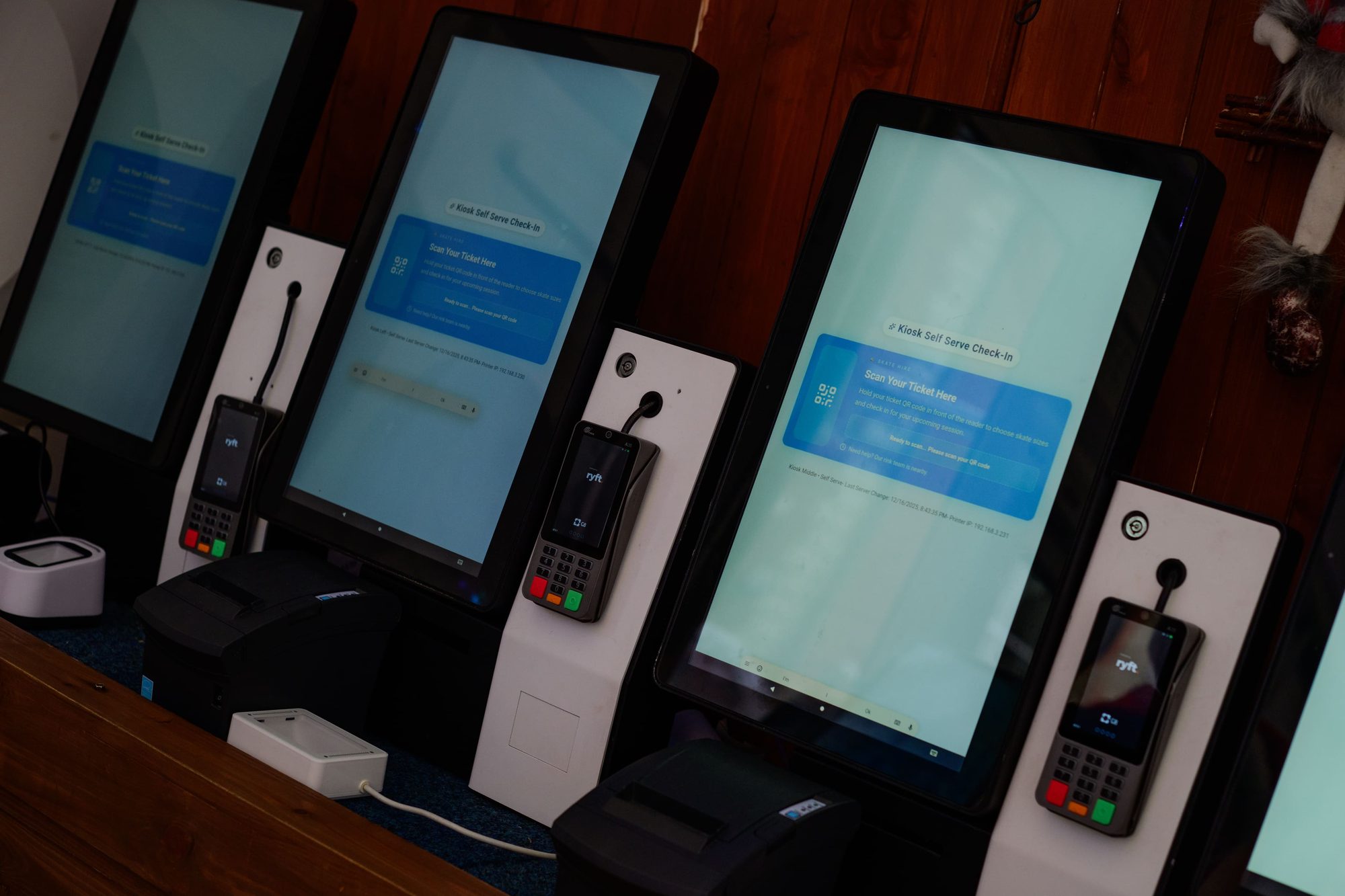
VenueOra takes Apple Pay, Google Pay and card payments online, on its own kiosks for walk-in tickets and on-site payments, and on card terminals registered to the venue, with refunds, reissues and payment on a terminal taken from the order record. At the bar, card payments on Posso tills and card machines are processed by VenueOra on the Posso platform; those tills are a separate system from the ticket record. Card payments run through a PCI DSS Level 1 acquiring partner, so card data never touches your tills, kiosks or lockers. QR check-in at the gate rejects a used ticket, and kiosks scan RFID and pair wristbands where the venue uses that hardware. LockVault, our smart-locker service, can be integrated with cashless wristbands and runs on VenueOra’s locker management, so a locker hire sits on the same record as the ticket. The festivals page covers ticketing, cashless and lockers for a greenfield site.
Sources
- UK Finance, Payment Markets Report 2025 press release, 19 August 2026 for contactless, cash and mobile wallet figures.
- UK Finance, Contactless cards information for the £100 single-transaction limit and mobile wallet treatment.
- FCA, FCA seeks views on removing £100 contactless limit, 14 March 2025 for the 2025 review.
- Apple, Tap to Pay on iPhone (UK) for accepting contactless payments on an iPhone.
- Boomtown Fair, What are Cash Free RFID Wristbands? for top-up and refund practice.
- Braehead Arena, Going cashless from September 2025 for the arena example.
- Visa, Account Information Security and PCI DSS merchant levels for merchant levels and validation.
- PCI Security Standards Council for the PCI DSS standard.